



Legislative Update: Nursing Home Oversight in Kansas
Libby Hastings • October 6, 2025
Legislative Update: Nursing Home Oversight in Kansas
On October 1st and 2nd, the 2025 Special Committee on Health and Social Services met, with the first day devoted to nursing home surveying and credentialing. The joint committee of both House and Senate members heard from the Kansas Department for Aging and Disability Services (KDADS), the Long-Term Care Ombudsman, industry representatives from Kansas and out of state, administrators, and contractors. Notably absent were the voices of consumers, their family members, and facility staff, the people most affected by long-term care policy.
The committee heard information about:
Survey Backlogs and Staffing Challenges
KDADS contracts with the federal government to inspect adult care homes for health and safety compliance. KDADS has struggled for years to meet federal requirements, due in large part to recruiting and retaining nurse surveyor positions. More than half of the 60 approved positions were vacant earlier this year. As a result, Kansas currently averages 19.9 months between nursing home inspections, far beyond the federal requirement of 12-15.9 months. With just over 300 federally licensed facilities in the state, timely inspections are critical to protecting residents.
To address this, KDADS eliminated 15 vacant positions and raised starting pay: up to $60,000 for multidisciplinary surveyors and $67,000 for RNs. The agency is also considering incentives to encourage more RNs to work as surveyors.
Kansas has one of the highest rates of the most serious deficiencies, known as Immediate Jeopardy (IJ) deficiencies, in the nation, citations for situations where resident health and safety are at serious risk. The committee explored the possibility of privatizing the survey process.
Resident Rights at Risk
Testimony also revealed troubling practices in some nursing homes, including charging residents $200–$300 per month in “pharmacy provider” or “medication set-up” fees
if they choose to use an outside pharmacy. This practice undermines residents’ right to choose their own providers and unfairly penalizes private-pay residents, already shouldering an average of $7,000–$8,000 per month in nursing home costs.
Involuntary Discharges and the Ombudsman’s Recommendation
The Long-Term Care Ombudsman urged lawmakers to expand discharge reporting requirements.
As she noted:
“Federal regulations require a notice to be sent to our office for a facility-initiated transfer (involuntary discharge) in federally licensed nursing homes, but that is not the case for state licensed homes, assisted livings, home pluses and residential health care facilities. With the help of our office, we can often help resolve the reason for the discharge notice to prevent a resident transfer or support the resident to ensure a transition occurs safely.”
The committee heard concerns from representatives of the nursing home industry and decided to delay making a recommendation on this issue, noting that additional information is needed.
KABC has advocated for not only strengthening the reporting requirements but also giving residents of assisted living facilities the same right to appeal an involuntary discharge that nursing home residents enjoy.
Raising the Personal Needs Allowance
The Personal Needs Allowance (PNA) for nursing home residents is a monthly stipend that Medicaid recipients can use for personal expenses. In Kansas, the PNA is just $62 per month. Many residents express concern that this amount is insufficient to cover basic personal expenses such as haircuts or undergarments. An immediate increase to the allowance is needed, along with an ongoing adjustment to keep pace with rising costs. The Long-Term Care Ombudsman recommended a PNA increase to the national average of $72 with an additional annual Cost of Living Adjustment.
KABC’s Position
KABC will continue to advocate for:
• Strong oversight of nursing homes.
• Resident rights protections, including freedom of choice in providers.
• Central inclusion of residents and staff voices in all policy discussions.
You can watch the hearing on the Kansas Legislature’s YouTube channel here.
KABC will continue to monitor these conversations closely as the 2026 legislative session approaches.
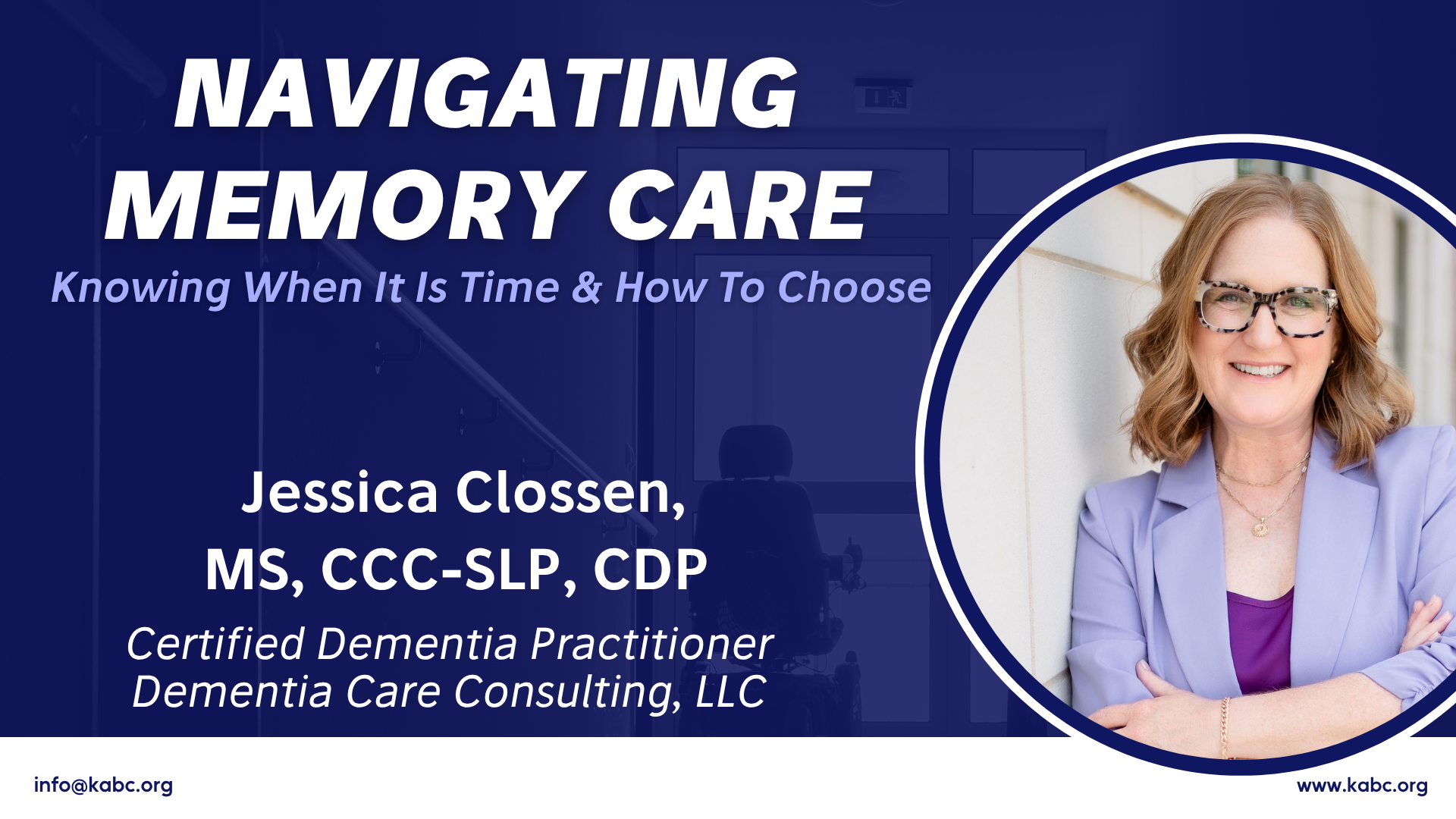
On Thursday, September 10th, KABC hosted our annual caregiver training, with speaker Jessica Clossen, and membership meeting. Over 30 people attended! The meeting began with a brief introduction to KABC by Libby Hastings, Communications and PR coordinator. Afterward, Karen Weber, KABC Board Vice President, led the membership meeting. During the membership and business meeting, Karen Weber (Vice President), Dave Ranney (Secretary), Rachel Stahle, Dustin Baker, and Deborah Merrill were unanimously voted to retain their current board positions. During the caregiver training portion, Navigation Memory Care: Knowing When It Is Time & How To Choose, Jessica Clossen discussed important tips for navigating memory care, including: The hidden cost of waiting too long and caregiver burnout Defining memory care Memory care transition guidance What to look for in a memory care setting Staffing and training Culture and activities Dining and daily routines We are so incredibly thankful to Jessica for sharing her time and expertize with our attendees. If you'd like to connect with Jessica Clossen, email her at jclossen@dementia-care-consulting.com or call 913-585-5178 . To view the recording of our 2026 caregiver training and membership meeting, please visit our YouTube page here. A copy of the presentation slides is available here .
Kansas has announced that it is exiting the Money Follows the Person (MFP) program, citing a drastic reduction in and possible elimination of federal funding. According to the Kansas Department for Aging and Disability Services (KDADS), the state had planned to reinstate the program on July 1 after several years of inactivity. Instead, Kansas is now withdrawing from the program altogether. For many Kansans, this decision represents a significant missed opportunity. The MFP program was created to help states rebalance their long-term services and supports systems by making it easier for people to move from institutional settings, such as nursing facilities, back into homes and communities. The program provided funding for critical transition expenses, including home modifications, furniture, bedding, kitchen supplies, and other necessities that help make community living possible. At its core, MFP recognized a simple truth: most people want to live in their own homes and communities, not institutions. Research consistently shows that older adults overwhelmingly prefer to age in place. In an AARP survey, 75 percent of older adults reported wanting to remain in their homes as they age. Yet many feel they will eventually have no choice but to move into a facility because the supports needed to remain at home are unavailable or unaffordable. Programs like MFP help bridge that gap. When people remain in nursing facilities despite being able to live safely in the community, there are consequences, not only for the individual, but for the state as a whole. First, individuals lose autonomy and control over their daily lives. Living in the community allows people to decide when they wake up, what they eat, who they spend time with, and how they participate in their neighborhoods. These choices may seem small, but they are fundamental to dignity and quality of life. Second, unnecessary institutionalization can contribute to social isolation. People living in their own homes can remain connected to friends, family, faith communities, volunteer opportunities, and local activities. Community integration promotes both physical and emotional well-being. Third, keeping people in nursing facilities when they could thrive in the community often comes at a higher cost to the Medicaid system. Home and community-based services are frequently less expensive than institutional care while also aligning with what most people prefer. Helping individuals remain in the least restrictive setting can benefit both taxpayers and the people receiving services. Finally, programs like MFP help remove barriers that prevent people from exercising their right to choose where they receive care. Transitioning from a nursing facility to the community is often not as simple as opening the front door and leaving. Many individuals need assistance securing housing, obtaining household items, modifying their homes for accessibility, or coordinating services. Without dedicated funding and support, these barriers can become insurmountable. Kansas has made progress over the years in expanding home and community-based services, but significant challenges remain. Housing shortages, workforce shortages among direct care workers, and waiting lists for services continue to make community living difficult for many people. The loss of Money Follows the Person means one fewer tool available to help Kansans return home.