



KABC Testifies Before Bethell Committee
Libby Hastings • October 16, 2025
KABC Testifies Before Bethell Committee
On Monday, October 13th, Dan Goodman, Executive Director of Kansas Advocates for Better Care (KABC), delivered testimony before the Robert G. Bethell Joint Committee on Home & Community Based Services & KanCare Oversight. His remarks focused on the urgent need to strengthen Kansas’ long-term care system through sustainable funding and workforce investments.
Goodman urged legislators to provide additional funding for the Home and Community-Based Services (HCBS) Frail Elderly waiver, noting projected shortfalls of $27 million in FY26 and $70 million in FY27. Without intervention, hundreds of older Kansans could face placement on a waitlist as early as this fall—delaying access to critical in-home services and increasing the risk of premature institutionalization.
He also highlighted the need to support and stabilize the state’s long-term care workforce
by exploring innovative approaches used in other states. For example, New Mexico’s Competitive Pay for Professionals program
has helped attract and retain workers by linking higher wages to improved reimbursement rates and accountability measures. Goodman suggested Kansas consider similar models to strengthen its caregiving workforce and ensure providers can offer competitive pay.
KABC remains committed to advocating for policies that promote quality care, protect older adults, and sustain a strong, well-supported caregiving system across Kansas.
Read KABC’s full testimony here: View Testimony (PDF)
Watch a full recording of the committee here: YouTube Link

KABC Testifies before the Kansas Silver Haired Legislature Kansas Advocates for Better Care (KABC) is urging state leaders to provide additional funding to eliminate the waitlist for the Home and Community-Based Services (HCBS) Frail Elderly (FE) Waiver, which helps older Kansans access the services they need to remain in their homes and communities. In testimony submitted to the Kansas Silver Haired Legislature (KSHL) on October 6 th in Topeka, KABC Executive Director Dan Goodman emphasized the importance of preserving access to in-home care and preventing older adults from entering nursing facilities before they need that level of care. The FE waiver waitlist, implemented July 6, 2026, has already affected hundreds of older Kansans. Without additional funding, more people could face delays in receiving essential services, potentially accelerating health declines and increasing the likelihood of premature nursing home placement. KABC is recommending $31 million in additional funding for the FE waiver in fiscal year 2027 to address projected funding shortfalls and help eliminate the waitlist. Kansas Silver Haired Legislature Sets 2027 Priorities On October 7 and 8, 65 delegates representing regions across Kansas gathered on the floor of the Kansas House of Representatives in Topeka for the Kansas Silver Haired Legislature's annual session. During the session, delegates approved five resolutions outlining their legislative priorities for 2027. The resolutions focus on supporting older Kansans' independence, financial security, access to care and participation in civic life. The five priorities are: Fund senior transportation Protect in-home care Increase funding for the FE waiver to help older Kansans receive care in their homes and communities. KABC supports this priority and is urging the state to add $31 million in funding for fiscal year 2027 to eliminate the FE waiver waitlist. Strengthen Medicaid Raise the Personal Needs Allowance Increase the Personal Needs Allowance for nursing home residents who receive Medicaid Protect senior voting rights These priorities address interconnected challenges facing older Kansans, from accessing transportation and affordable care to maintaining independence and financial security. The Importance of Care at Home The FE waiver was established to help older Kansans access community-based services that allow them to remain in their homes for as long as possible, delaying or avoiding the need for more costly institutional care. These services can make a significant difference in an older adult's ability to maintain independence, health and quality of life. When needed support is unavailable, however, individuals and families may have fewer options for managing care at home. Kansas already faces challenges in this area. According to the United Health Foundation's America's Health Rankings, Kansas ranks 47th in the nation for placing low-care residents in nursing facilities. KABC is concerned that limiting access to home- and community-based services could contribute to further premature institutionalization. The Cost of Delayed Access The potential impact of the waitlist is significant. According to KABC's testimony, the state faces a projected $31 million shortfall for the FE waiver in fiscal year 2027, putting access to critical in-home services at risk. Historical data also illustrate the potential scope of the problem. In 2003, a similar FE waiver waitlist affected approximately 20% of eligible participants. The Kansas Department for Aging and Disability Services (KDADS) reports that 9,306 Kansans are currently eligible for the waiver. Applying that historical 20% figure to today's eligible population suggests that approximately 1,861 older Kansans could be affected in fiscal year 2027. While this estimate is based on a historical comparison, it underscores the potential consequences of insufficient funding. Investing in Older Kansans The goal is to help older Kansans receive the services they need when they need them, rather than risk declining health or entering institutional care because community-based options are unavailable. As Dan Goodman emphasized in his testimony, investing in home- and community-based services offers an opportunity to support older adults' independence while potentially avoiding the greater costs associated with premature institutionalization. The Kansas Silver Haired Legislature's 2027 priorities provide a framework for addressing the needs of older Kansans across the state. KABC's support for increased FE waiver funding aligns with the Legislature's call to protect in-home care and ensure older adults have meaningful choices about where and how they receive care. KABC will continue advocating for policies and resources that protect older Kansans' access to quality long-term care, wherever they call home.
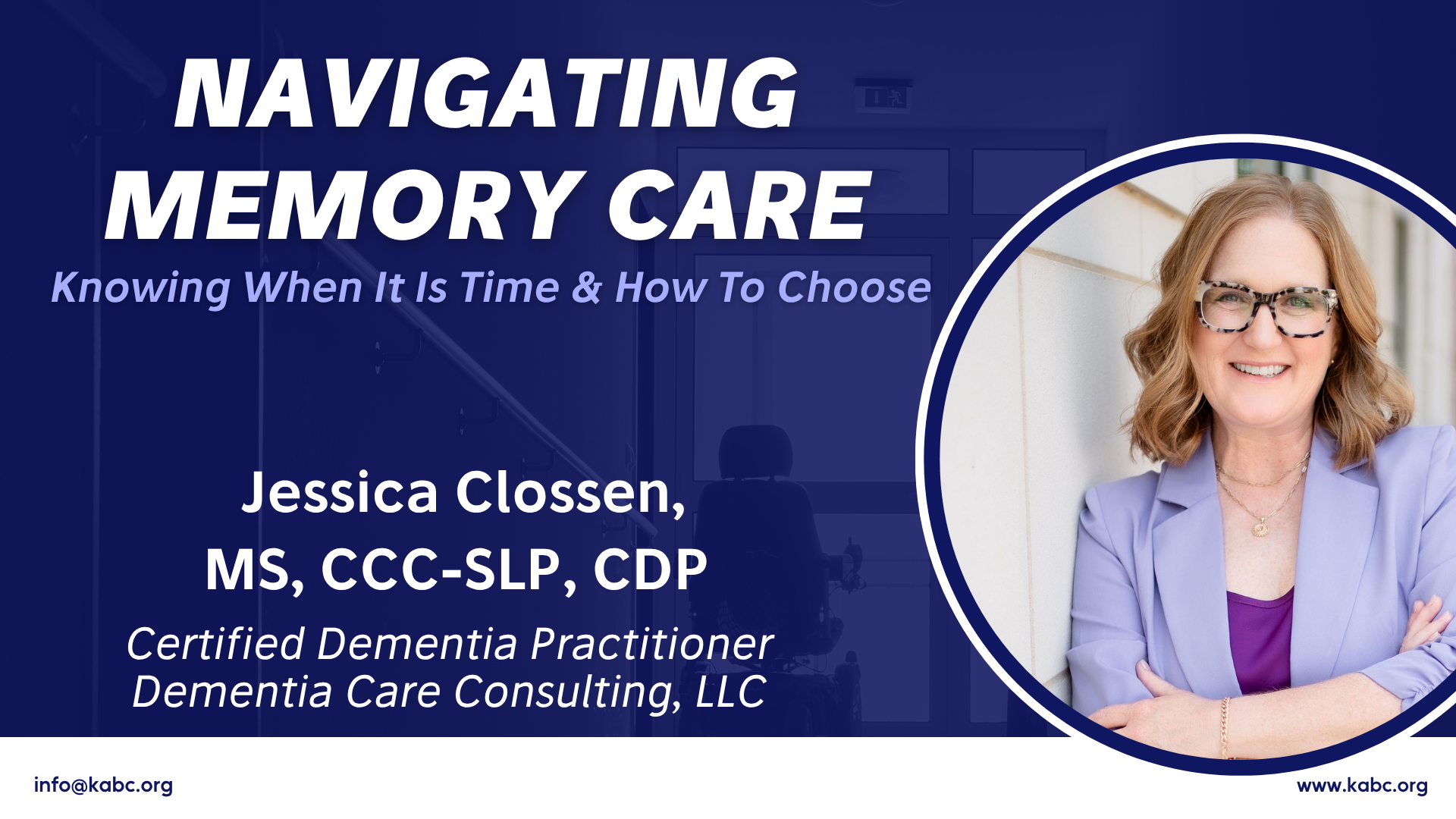
On Thursday, September 10th, KABC hosted our annual caregiver training, with speaker Jessica Clossen, and membership meeting. Over 30 people attended! The meeting began with a brief introduction to KABC by Libby Hastings, Communications and PR coordinator. Afterward, Karen Weber, KABC Board Vice President, led the membership meeting. During the membership and business meeting, Karen Weber (Vice President), Dave Ranney (Secretary), Rachel Stahle, Dustin Baker, and Deborah Merrill were unanimously voted to retain their current board positions. During the caregiver training portion, Navigation Memory Care: Knowing When It Is Time & How To Choose, Jessica Clossen discussed important tips for navigating memory care, including: The hidden cost of waiting too long and caregiver burnout Defining memory care Memory care transition guidance What to look for in a memory care setting Staffing and training Culture and activities Dining and daily routines We are so incredibly thankful to Jessica for sharing her time and expertize with our attendees. If you'd like to connect with Jessica Clossen, email her at jclossen@dementia-care-consulting.com or call 913-585-5178 . To view the recording of our 2026 caregiver training and membership meeting, please visit our YouTube page here. A copy of the presentation slides is available here .